
#6 - Pre-Spring Cleaning
An unexpected voicemail, how birds were once stewards of the earth, and reflections on winter

I was cleaning out my voice mails when I heard my dead grandfather speak. Among all the automated messages about car insurance, he was there.
“Hey Gabe, you can come pick me up now. I’m ready.”
He must’ve finished his dialysis appointment.
I closed the voice mail and decided that I was done for the night.
The next morning, I found my wife deleting more than 400 tabs in her iPhone browser.
“Isn’t it funny?” she said, as she scrolled through all the tabs. “I remember what I was doing when I first opened some of these.”
It got me thinking how much of our lives are conducted through read or unread texts, interactions left hanging as voicemails in an ever-deepening inbox. How the traces of daily life quickly become digital dust.
I began to wonder what random thing of mine—photos left up in the cloud, tossed off song ideas in an untitled file—will be lucky enough to survive in a few decades, if at all.
My mom cleaned out the garage recently. She said that she wanted to clean up as much as she can because she didn’t want me to deal with any of it when she’s gone.
I thought, won’t you still be alive for a long time? Isn’t it too early to be preparing for such things? But then, just like scrolling through old voice mails, a few years can be traversed in a few seconds and before you know it, you’re at the end of the list.
“We’ll cross the bridge when we get there,” I said.
“No,” Mom said. “You better be prepared when the time comes.”
As she stacked boxes packed with old video tapes and receipts, yellow fur drifted among the dust.
“Gaya’s hair is still everywhere,” she said.
My old dog.
Even though my parents own a fancy vacuum, parts of her still linger in the corners.
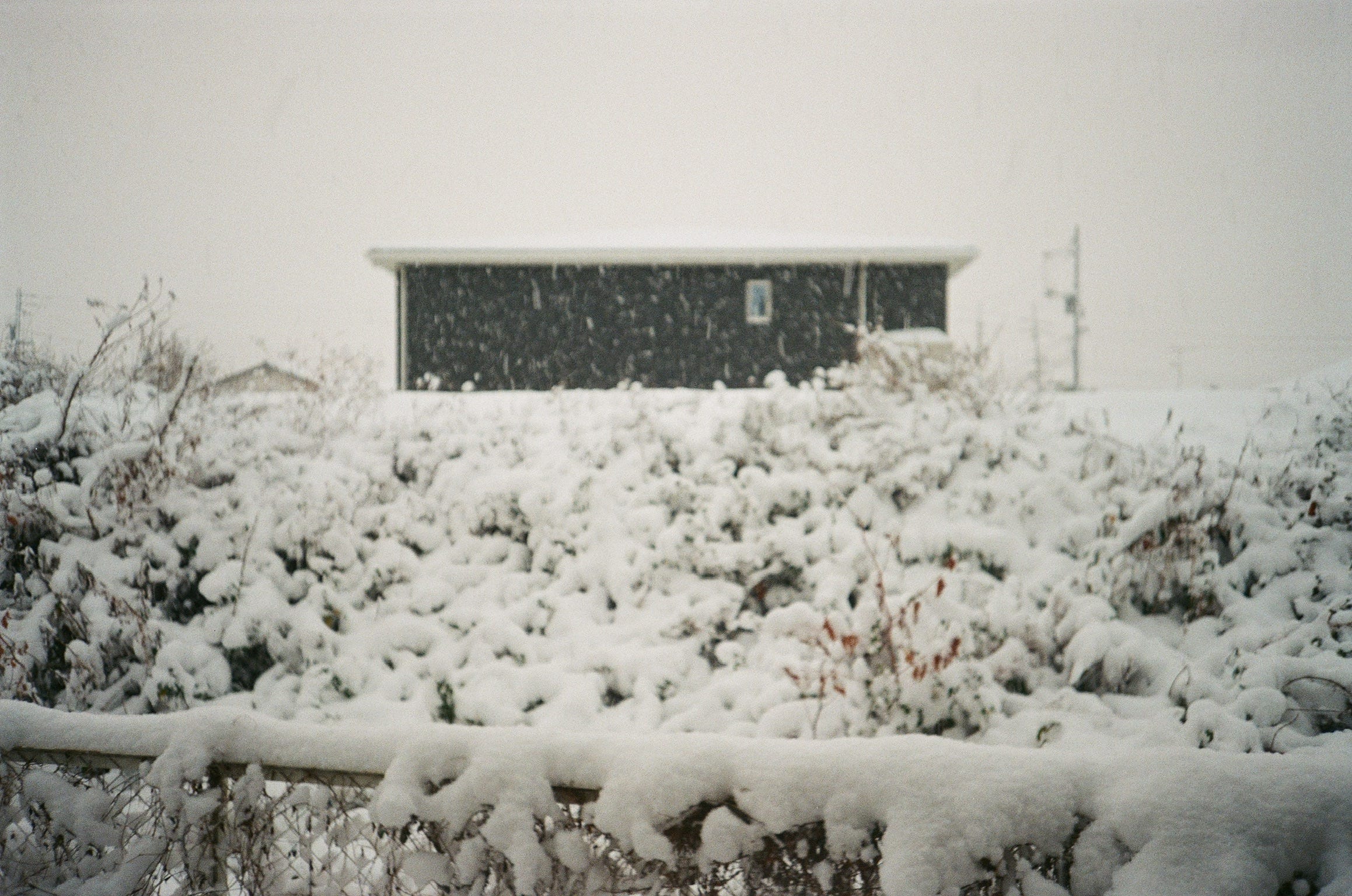
This year’s winter has given me a case of chilblains. I’ve never had to deal with it before in my life. I’ve gotten into the habit of wearing a double pair of socks to keep my toes from blistering.
Nearby, Japanese wagtails were eating scattered crumbs in the playground. I could hear their chirps in the frigid air before I saw them take flight. The nature writer, John Burroughs, once wrote:
“All sounds are sharper in winter; the air transmits better.”
—From “The Snow-Walkers”
My mom told me that hearing is the last thing to go. I don’t know if that’s true or not but when my grandma was in a coma near the end of her life, whenever we talked to her, the lifeline on her monitor would jump. It seemed our voices were giving her an extra bit of life. Maybe that’s only wishful thinking.
In winter, something is always weighing on another. Sachets of snow push the branches to bow while ice stifles the creek to a crawl. All the leaves have a forlorn, rag-like wilt. Life slows down. But even when the landscape is at its stillest, traces of activity remain. Shoe prints leading to the dumpster. Tire tracks curving at the street corner. The Y-shaped stamp of hopping birds. In their absence, something stays behind.
Senses are numbed but coffee burns the tongue more easily. A hot bath more readily shakes the body out of its brittle stiffness. The marks of living things leave more of an impression.
The following morning, road workers threw salt onto the road. Not long after they finished, a storm touched down, and the sun was blotted out by a dark curtain of clouds, gray as pewter. The snow, struck by the thrust of wind, blew sideways.
How do the wagtails endure this blizzard?
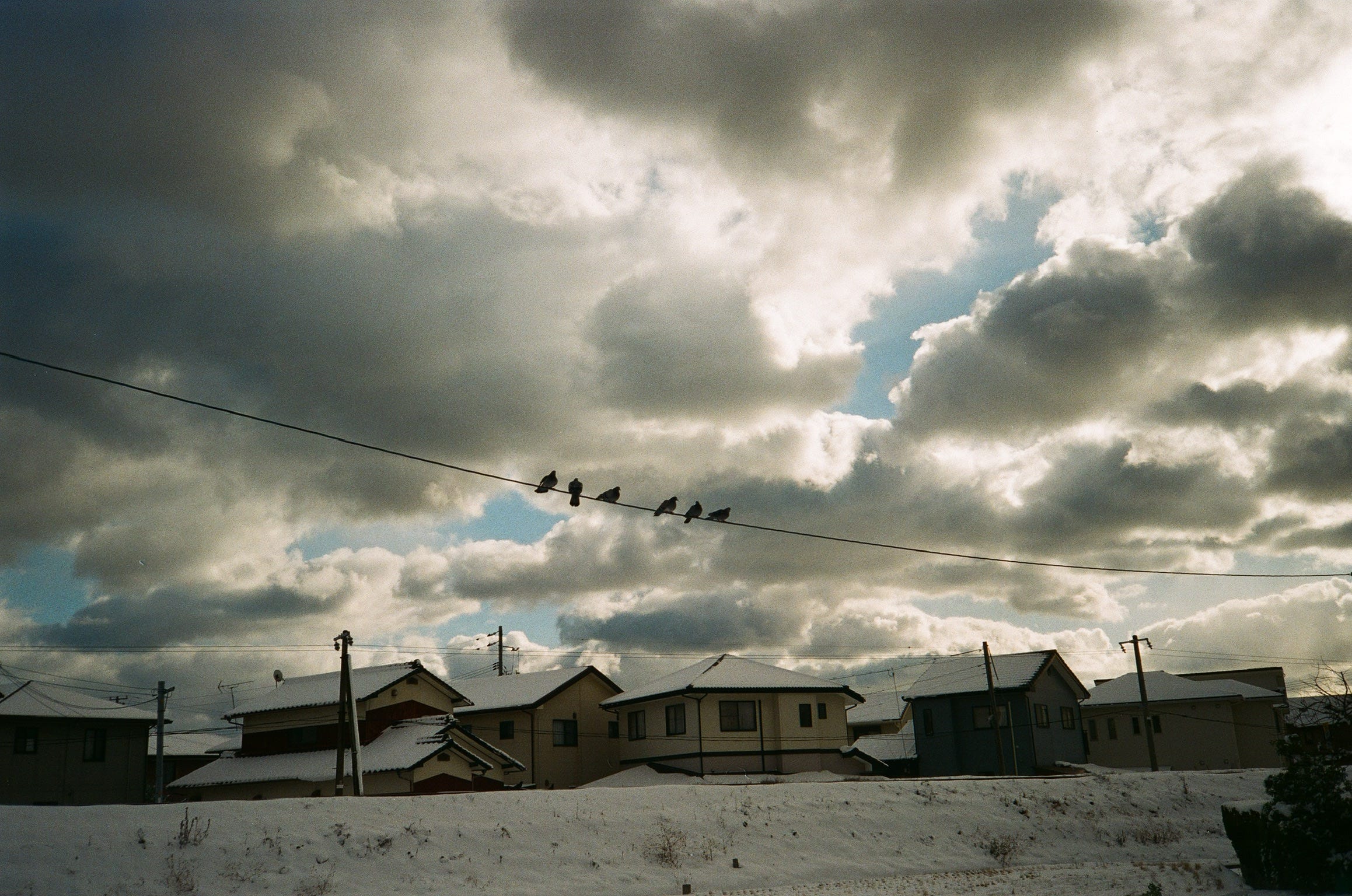
The morning after the storm, wagtails perched on gables and power lines to survey the town.
In Ainu mythology, the Creator sent a wagtail down to earth, which, back then, was nothing more than a primordial swamp. Taking in the desolation, the wagtail wondered how to carry out such a heavy task. But, through his labors, the world became habitable:
“He fluttered over the water with his wings, trampled upon the muddy matter with his feet, and beat it down with his tail. After a very long time of fluttering, trampling, and tail-wagging, dry places appeared and the waters became the ocean.”
—From “Items of Ainu Folklore” by John Batchelor
Maybe that’s why they perch high up on power lines and tree branches. To take in their work.
A flock of wagtails used to regularly hang out on the fence by my bedroom window. The flight of their tiny bodies would knock softly against the glass. Every time I’d draw the curtain to get a better look, they’d scatter upwards like leaves caught in a dust devil. So, I contented myself with watching their flittering shapes through the closed curtain, fluttering this way and that, a sort of natural shadow play.
The next morning, the side yard would be a Pollock painting of white excrement.
From the train window, particles of snow drift like blown dust off an old book.
By the time we stepped off the train and exited the gate the sun was out and the clumps of snow on the side of the road began to thaw.
To walk in the snow is to invite a contemplative spell of longing. Longing for warmer days, the comfort of a heated blanket, or a conversation with someone that is no longer there. The snow, in making us button up our coats, also makes us prone to shutting away our thoughts. I don’t share as readily in winter as I do in summer. Partly because opening one’s mouth to speak in such terrifying cold invites a numbing pain. Best to save your body heat and keep trudging through. One hurries with a renewed urgency. I find myself quickening my pace whenever I’m in the shade so I can bask in the sun.
We stayed in Kyoto for one night before taking the train northeast into Shiga Prefecture, skirting the southeastern edge of Lake Biwa. It began to snow again. The white hills grew into mountains while the fields stared back in awestruck blankness. At the next station, we took a taxi farther out. We went over a bridge that had sprinklers installed to help douse some of the ice off the windshield.
At our drop off point—a buried bus stop surrounded by traditional houses—A-san and K-san were already waiting for us.
K-san lead us to a gallery and cafe about a 10 minute walk from his house. As we settled in the tatami room, which had been converted into the main cafe space, chunks of snow slipped off the roofs.
The cafe owner told us that he has seen UFOs three times. There are a lot out here, he said. I imagine that since the sky is so clear out in the country, one may catch sight of something strange among the stars. A friend once asked me:
“Why don’t you believe in aliens, Gabe?!”
“It’s not that I don’t believe in them,” I said. “It’s that they have no impact on my life, so…”
“That’s so selfish!”
Maybe they do affect my life for all I know.
As we left the cafe, an old man rang the temple bell. Since it’s so quiet out here, one feels a heightened sense of sound and touch. One’s nose, ears, hands, and feet burn while the peal of a bell shakes your bones with an almost painful clarity. It hurts to be outside.
My mom used to say that when she was a child, there would be so many herons standing in the rice field that it would appear pure white. But now, due to humanity’s impact on the land, there are fewer of them. We are, at an unprecedented rate, undoing all the work that the birds have done for us. What nature bestows, we lay to waste.
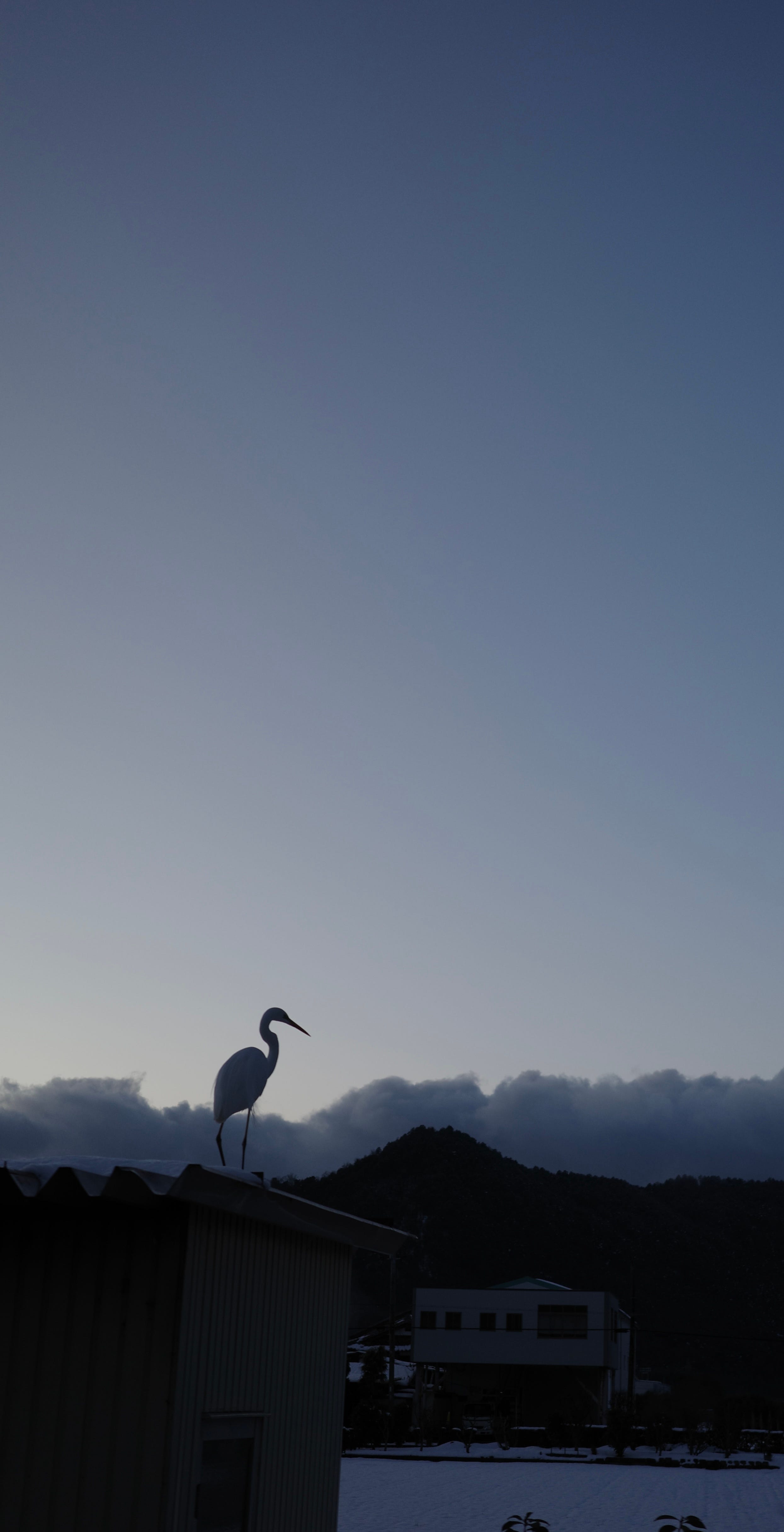
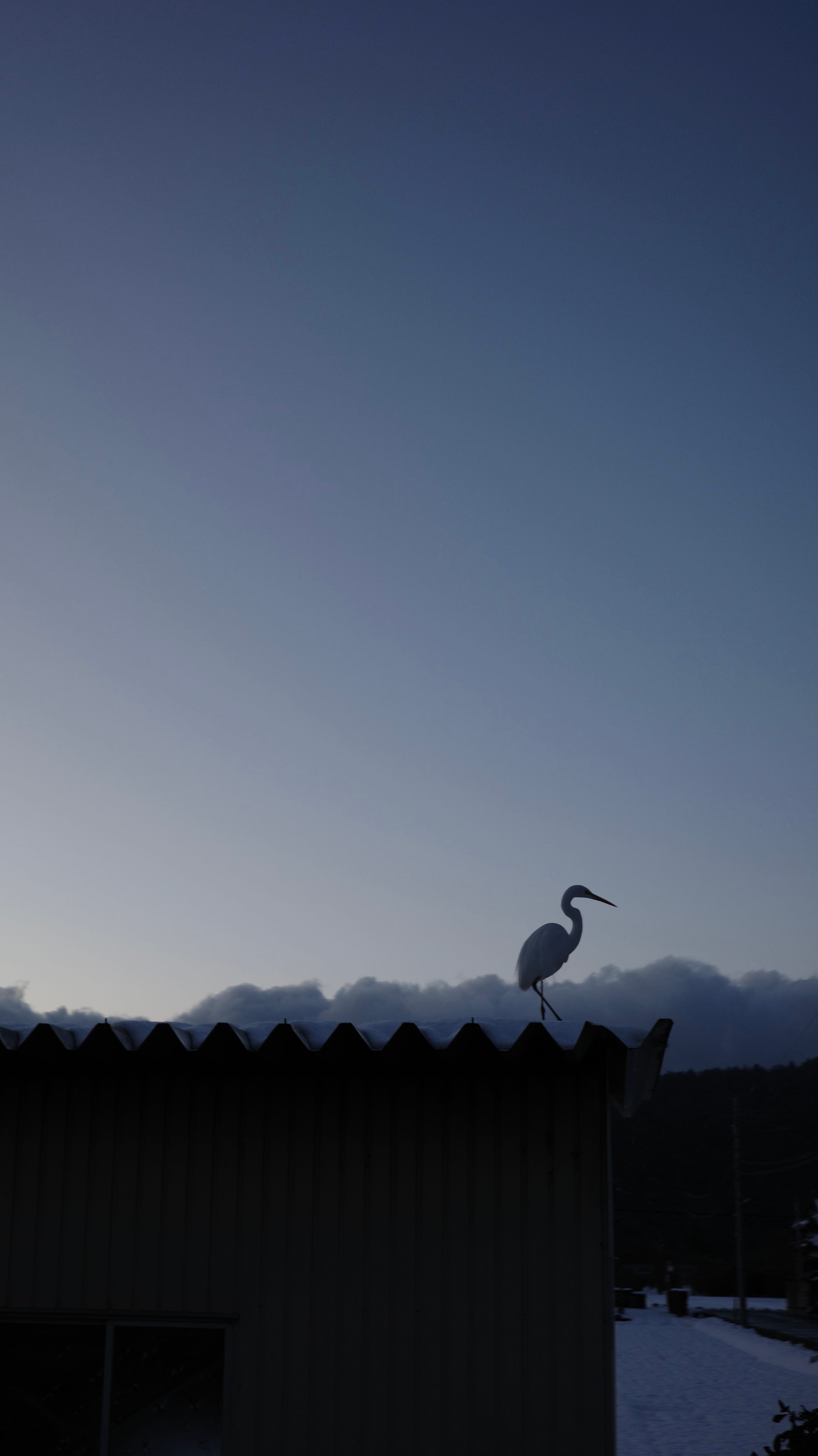
The heron crept to the edge of the roof. He crossed his thin legs and gazed at the vast frozen land, as though charting his flight. Only when he had turned his needle-like beak towards the clouds did he beat his wings, taking off towards the fleece-like clouds, smoldering blue in the dusky light.
“Look at him. Isn’t he cold?”
Our friend and guide, K-san, pointed at a half-buried statue of Buddha, the snow gathered up to his chest. Only our footprints stood out among the smooth white surface of the temple grounds. The light was dimming fast. We continued our walk around the neighborhood, leaving the statue to meditate under the clumps of ice.
“K-san,” I asked, “have you ever seen a ghost?”
He told me that he hasn’t seen one personally but has felt some sensations of the supernatural.
“When I was still a university student in Osaka, I woke up one day with a headache. I had a strange feeling that something was wrong so I went back to my parents’ home in Kyoto. When I got there, they were getting ready to go to the hospital. They told me that my grandma had just passed away.”
I’ve yet to see a ghost. I don’t believe in them. But I do believe in the importance of telling ghost stories, in how they allow us to conceptualize pain, regret, absence, and love. To tell each other stories, whether of the fantastic or the strange, is an animating principle, a fire to keep burning in these short frigid days, and long shivering nights.
On the train ride back to Kyoto, a wave of utter, stone-limbed exhaustion caught up with me. My wife wisely stayed in the hotel room while I searched for dinner. People in puffy jackets and stylish long coats sidled past each other in the cold, some stopping to stare at sample menus in the window while taxis picked up and dropped off a fresh wave of tourists out on the town.
I realized quickly that it was a mistake to go out. To escape the cold, I rushed into the nearest noodle stall and took a seat at the counter. A lady pleaded with the staff if she could pay with card.
“Please, I’ve had a long day. I don’t have cash on me.”
The old waiter was apologetic.
“Sorry,” he said. “Only cash.”
Without saying another word, the lady got up, and opened the front door. A whipping cold wind blasted into the restaurant, and I, being seated close to the front, buried my chin into my collar. The lady fidgeted with the door, not grasping that the thing was automatic. But the longer she tried to force the automatic door closed, the longer it stayed open, and the more the wintry air blew in. Some of the patrons in the ramen shop gazed up from their steaming bowls of soup to stare puzzlingly at the embarrassed lady. Eventually, she gave up, thankfully, allowing the door to return to its closed position.
That same night, I caught a fever with chills. I can’t remember the last time I had a fever. I tossed and turned in the hotel bed as my back trembled and teeth chattered.
Getting sick threw me back into a world of childish helplessness where I became acquainted again with the comfort and annoyance of being looked after. My wife rolled up a damp towel and placed it on my forehead. My eyes roasted in their sockets as my breath, hot as steam, burned against the roof of my mouth. As I closed my eyes, a pulsating white wall seemed to push against me, and with it, all the fevers of childhood tumbled back onto me—sitting in the backseat of my mom’s car, being driven to the doctor’s office, the wire block toys in the waiting rooms of yellowing wallpaper, that sterile smell I would later find out to be hydrogen peroxide, the thin onion-skin sheet of paper draped on the patient’s chair, and the rain-like crinkling it’d make whenever I nervously sat on it.
I take back any romantic feelings I had for snow and snowy landscapes.
I always wondered why, when I was sick as an adult, my memories always return, just as waves come and go, to the shores of my childhood. John Berger wrote:
“When we suffer anguish we return to early childhood because that is the period in which we first learnt to suffer the experience of total loss. It was more than that. It was the period in which we suffered more total losses than in all the rest of our life put together.”
—From “A Fortunate Man”
Suddenly it struck me that, if ghosts are real, then my grandparents have watched me through all the embarrassments of my adult life. Maybe they could even see me right now, groaning and complaining in bed. I tried to be optimistic about a quick recovery, as if to show the hypothetical spirits that I was determined to be strong about my situation. But really it’s hard to be lively and longing at the same time.
The next morning, my sweater was soaked through with fever sweat. Gross but a good sign. Loading up the suitcase, though, was still a difficult task as all the fatigue and muscle ache caused me to move with a sluggish hesitancy. After a long preparation, we were ready to head back home.
The taxi driver was an old man with a bald, tanned head populated by a few strands of gray hair. When we climbed into the car, he was chewing on long potato crisps. There were doilies on the windows and seats. The smell of cigarettes mingled with the odor of sweet lozenges. He spoke with an enthusiasm that brought to mind old cartoon characters who communicated through large stage-like gestures. As he took us down Kawaramachi, there was a small TV on the dashboard playing black and white footage of Showa era pop stars.
“How nostalgic,” he said. He unmuted the TV and a round of applause filled the cab as Ayumi Ishida took the stage to sing “Blue Light Yokohama.” The song has such a simple melody underscored with a delightful interplay between trumpets, guitar, and strings. The tempo strolls and ambles in a sort of cha-cha rhythm, evoking a night time walk by the Yokohama harbor. Its yearning, melodramatic sound glimmers.
The old man drove herky-jerky, with sudden stops and starts that lunged our bodies forward. It took me a while to notice that he was wearing a hearing aid.
During the drive, he turned around and stretched out a white-gloved hand.
“Here, take some cough drops.” He gave me two, folded neatly in a silver wrapper. They tasted like oranges.
When he dropped us off at our stop, I paid him the fare but he gave back 100 yen and a slap on the knee. I tried to argue with him but he laughed it off. I was shocked by his generosity and youthful energy.
“Thank you for teaching me about classic songs,” I said.
“I used to see her on the big screen,” he said.
As we got out of the car, he gave one final wave. I waved back.
For the past few nights, I’ve heard a low hum. The neighbors’ heaters are running late into the night. But soon enough, they won’t need to use them. Today is one of those rare days when the sun, doing more than just peeking through the clouds, throws them off like an enthusiastic little kid tossing his blanket off the bed. I take out the carpet and smack off all the dust that has accumulated over the winter, picking off the dust bunnies, and chasing away the lint that tries to tumble back into the apartment. Soon, it will be warm again.